

The microscope analogy
How researchers attack the wrong problem
“What we observe is not nature itself, but nature exposed to our method of questioning.”
— Werner Heisenberg
Dear Researcher,
When data doesn’t make sense
Researchers instinctively fix the analysis
To be clear: If you struggle with “non-significant” statistics despite solid lab experiments, you should definitely register for our webinar.
But in many cases, that’s not the real problem
Here’s a simple way to see it
(in 1 minute):
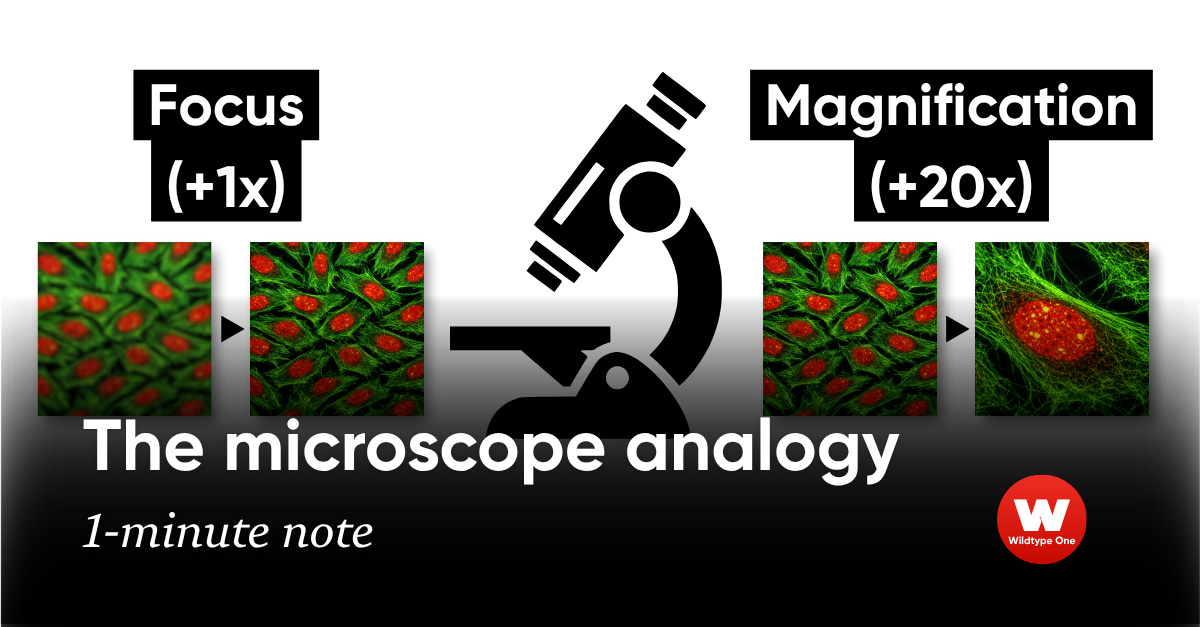
The microscope analogy
Imagine you’re looking at a sample under a microscope
If the image is blurry
You adjust the focus
And it gets a bit clearer
That’s what statistics do
They sharpen what you already see
But if you’re using the wrong magnification
(e.g.: 20x vs. 63x)
No amount of focusing will show what you’re trying to observe
It’s the same in the lab
If you fine-tune the analysis
But conclusions don’t improve
You’re simply not looking at the right level
That’s not a statistics problem
That’s a measurement problem
Most researchers adjust the focus
Few question the magnification
How to do it
Ideally, you’d want a standard protocol like kinome profiling that scans all activity in your cells.
If that’s not a good fit, you have alternatives
Basically, look for a better measurement
To verify, ask 3 questions:
Step 1 — Are you improving clarity or changing what you can see?
You refined your analysis,
Changed tests,
But didn’t move closer to publishing?
And not even getting meaningful figures?
You’re likely not seeing the system more clearly
You’re just analyzing the same limited view
Step 2 — Are your outputs fragmented?
Flow cytometry
Western blots
qPCR
Imaging
ELISA
Each gives a piece
But if you’re stitching conclusions together
You may be limited by magnification
Kinome profiling can help standardize (unify) your conclusion here.
Step 3 — Can you directly observe what’s driving the phenotype?
If you’re looking through only 1-3 antibodies
It’s difficult to make big conclusions
If the answer is no
You’re interpreting a proxy
Not the system itself
Final rule
If your analysis keeps improving
…but your conclusions don’t
Stop adjusting the focus
Question the magnification
Change your measurement.
As promised, better science in 1 minute or less.
See you next week,
— Carl from Wildtype One 🧬
PS - If you struggle with “non-significant” statistics despite solid lab experiments, register for our webinar.
PPS - If scanning all 400+ major signaling pathways using 20µL of extracts in one run makes sense for you, you can do a short fit assessment.